








War Against Melanoma
The WAM Foundation
1478 Sunflower Street Lewis Center, OH 43035
Email: info@thewamfoundation.org
1478 Sunflower Street Lewis Center, OH 43035
Email: info@thewamfoundation.org
Signs and Symptoms
Information on this site was obtained directly from the National Cancer Institute and The Skin Cancer Foundation, two excellent resources for detailed
information about melanoma. For more information, please go to:
National Cancer Institute - http://www.cancer.gov/cancertopics/types/melanoma
The Skin Cancer Foundation - http://www.skincancer.org
Disclaimer: The material contained on this site is for informational purposes only and is not intended and should not be construed to be a substitute for professional medical advice, diagnosis or treatment. You should not rely on any information contained on this site as a substitute for medical advice and always seek the advice of your physician or other qualified health provider with any questions or concerns you may have regarding a medical condition.
National Cancer Institute - http://www.cancer.gov/cancertopics/types/melanoma
The Skin Cancer Foundation - http://www.skincancer.org
Disclaimer: The material contained on this site is for informational purposes only and is not intended and should not be construed to be a substitute for professional medical advice, diagnosis or treatment. You should not rely on any information contained on this site as a substitute for medical advice and always seek the advice of your physician or other qualified health provider with any questions or concerns you may have regarding a medical condition.
Often the first sign of melanoma is a change in the shape, color, size, or feel of an
existing mole. Melanoma may also appear as a new mole. Melanomas can vary
greatly in how they look. Many show all of the ABCDE features shown below.
However, some may show changes or abnormal areas in only one or two of the
ABCDE features.
In more advanced melanoma, the texture of the mole may change. The skin on the
surface may break down and look scraped. It may become hard or lumpy. The
surface may ooze or bleed. Sometimes the melanoma is itchy, tender, or painful.
Thinking of "ABCDE" can help you remember what to look for:
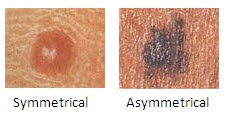
A - Asymmetry
If you draw a line through the mole on the right, the two
halves will not match.
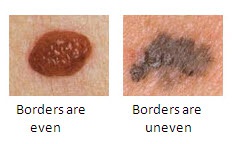
B - Border
The borders of an early melanoma tend to be uneven.
The edges may be scalloped or notched.
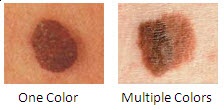
C - Color
D - Diameter
E - Evolving
Having a variety of colors is another warning signal. A
number of different shades of brown, tan or black could
appear. A melanoma may also become red, blue or some
other color.
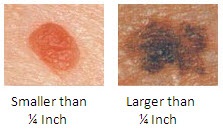
Melanomas usually are larger in diameter than the size of
the eraser on your pencil (1/4 inch or 6 mm), but they
may sometimes be smaller when first detected.
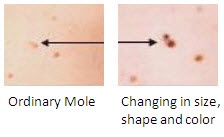
Any change - in size, shape, color, elevation, or another trait,
or any new symptom such as bleeding, itching or crusting -
points to danger.